Tattoo History: The Origins, Traditions, and Cultural Significance of Tattoos Throughout Time
Tattooing is among the oldest and most geographically widespread forms of body modification practiced by humans. Archaeological and anthropological evidence places tattooing across nearly every major civilization and culture, spanning at least 5,000 years of recorded history — and likely much longer. Understanding the history of tattooing requires examining its varied functions: therapeutic, spiritual, social, punitive, and aesthetic.
This article surveys the major tattooing traditions across different regions and time periods, drawing on archaeological discoveries, historical records, and ethnographic research.
Earliest Known Evidence: Otzi the Iceman (c. 3300 BCE)
The oldest confirmed tattooed human remains belong to Otzi the Iceman, a naturally mummified body discovered in the Otztal Alps on the Austrian-Italian border in 1991. Carbon dating places his death at approximately 3300 BCE. Otzi bears 61 tattoos consisting of simple lines, crosses, and dots, applied using soot or carbon-based pigment introduced via small incisions in the skin.

The placement of Otzi's tattoos is clinically significant: the majority are located over joints and areas of the spine where he is known to have suffered from arthritis and degenerative disease. Researchers have proposed that these markings may have served a therapeutic function analogous to acupuncture, predating the earliest documented Chinese acupuncture practices by over a millennium. This remains a subject of ongoing academic discussion.
Ancient Egypt (c. 2000 BCE and Earlier)
Tattooed mummies from ancient Egypt have been recovered dating to approximately 2000 BCE, with some researchers suggesting evidence of tattooing as far back as 4000 BCE based on figurines and artifacts. Earlier scholarship assumed Egyptian tattooing was limited to women and associated with fertility or ritual roles. However, discoveries at Deir el-Medina and analyses of the mummy known as "Gebelein Man B" have revealed tattooed male remains as well, revising earlier assumptions.


Common Egyptian tattoo motifs include the dwarf deity Bes — associated with protection during childbirth — as well as geometric patterns, baboons, and eyes of Horus. The iconography suggests a primarily apotropaic function: tattoos intended to protect the wearer from harm or invoke divine favor. Some researchers have also linked tattooed markings to professional or religious roles within Egyptian society.
Polynesia: Tatau and the Origins of the Modern Term
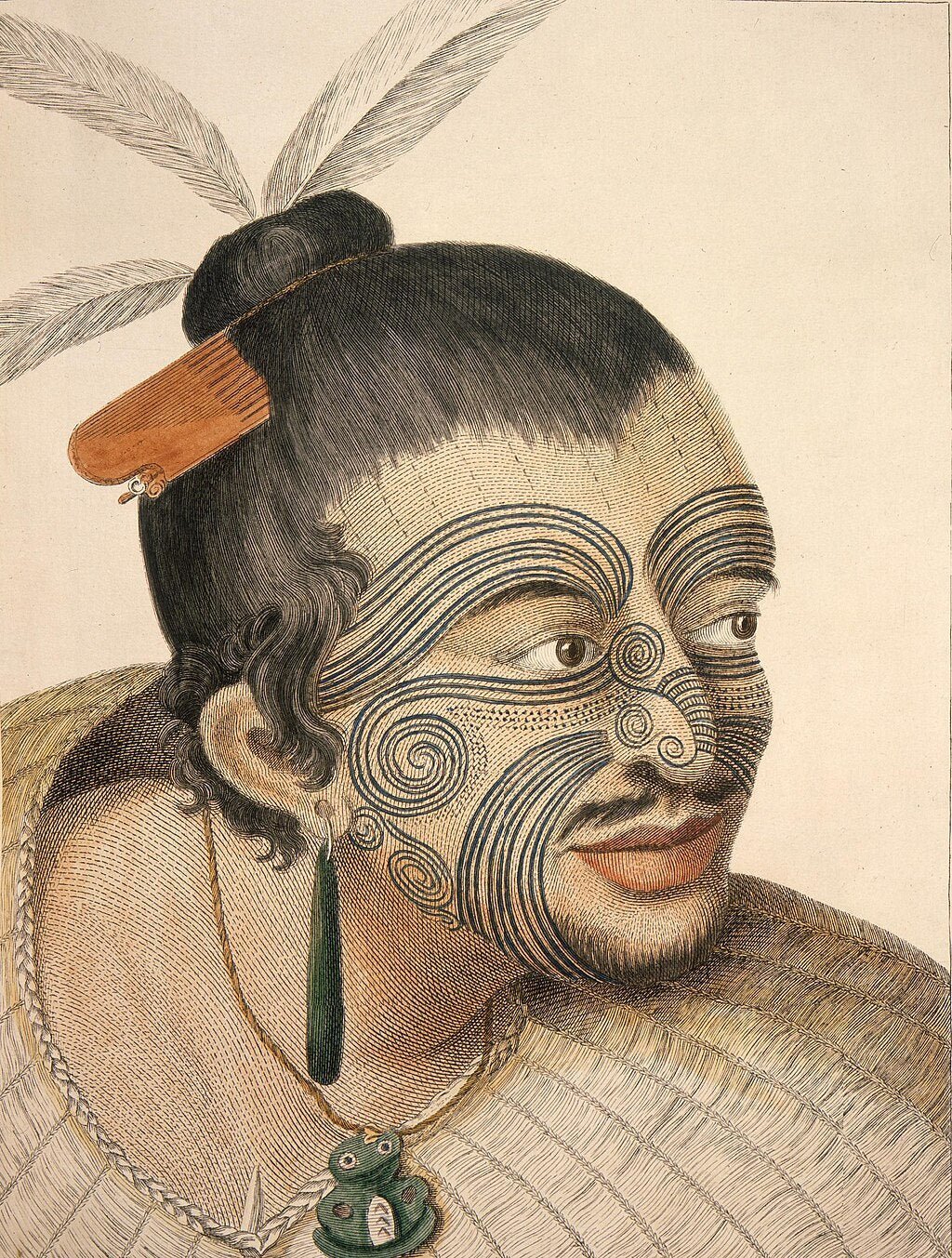
The English word "tattoo" derives from the Polynesian term tatau or tatu, introduced to European languages by members of Captain James Cook's first voyage (1768–1771), who encountered tattooed individuals in Tahiti and New Zealand. Polynesian tattooing traditions are among the most extensively documented and culturally complex in the world
In Maori culture, the facial tattoo known as ta moko functions as a form of identity record. The patterns encode genealogical data — including lineage, tribal affiliation, rank, and personal history — through a distinctive system of spirals and curved lines. Each ta moko is unique to its bearer and was historically read as a form of identification equivalent to a written document. The practice declined significantly during the colonial period but has experienced substantial revival since the late 20th century.

Across Samoa, Tonga, Hawaii, and the Marquesas Islands, tattooing served as a marker of social status, spiritual protection, and group membership. Traditional Samoan pe'a (male) and malu (female) tattoos are applied using a hand-tapping technique with combs made from bone or tusk, a method largely unchanged for centuries. The process is physically demanding and carries significant cultural weight as a rite of passage.

Japan: Irezumi and Its Historical Contexts
Evidence of tattooing in Japan dates to the Jomon period (approximately 10,500–300 BCE), based on clay figurines bearing facial markings interpreted by some scholars as tattoo representations. The practice evolved considerably over subsequent centuries. During the Kofun period (300–538 CE), Chinese diplomatic records describe Japanese men bearing tattooed faces and bodies.
By the Edo period (1603–1868), tattooing in Japan occupied dual social roles. It was used as a punitive practice — convicted criminals were marked with rings or kanji characters to identify them permanently. Simultaneously, a sophisticated decorative tradition developed among artisans and laborers, eventually evolving into irezumi: large-scale, highly detailed body tattooing incorporating mythological figures, landscapes, flora, and fauna. The tools and pigments used in irezumi were refined over centuries by specialist craftspeople, producing a distinct aesthetic that remains globally influential.

Tattooing was banned by the Meiji government in 1868 as part of broader modernization efforts and concerns about Western perception of Japan. The ban was lifted in 1948 following the Allied occupation. Irezumi's association with organized crime (yakuza) during the 20th century contributed to ongoing social stigma in Japan, though the art form has gained wider international recognition and academic study.
Indigenous Americas: Pre-Columbian and Historical Traditions
Tattooing was practiced across a broad range of indigenous cultures throughout North, Central, and South America prior to and following European contact. Archaeological evidence includes tattooed mummies from the Chiribaya culture in coastal Peru (900–1350 CE) and the Paracas and Nazca cultures, whose remains bear zoomorphic and geometric designs.

Among various Plains tribes of North America, tattoo marks served as records of warrior achievements and spiritual protection. The Haida and other Northwest Coast peoples integrated tattooing into complex systems of clan identity, crest display, and ceremonial practice. Inuit peoples of the Arctic — including the Yupik and Inupiaq — practiced a tradition of women's facial and hand tattooing called kakiniit, which marked life transitions such as puberty and marriage and held spiritual significance related to the afterlife. Kakiniit was suppressed during the 20th century through missionary and government interference, but has seen active revitalization in recent decades.

South and Southeast Asia: Sacred and Ritualistic Practices
The practice of Sak Yant — sacred geometric tattooing performed by Buddhist monks and brahmin priests — has been documented in Thailand, Myanmar, Cambodia, and Laos for several centuries, though its origins are difficult to date precisely. Sak Yant designs incorporate Pali or Sanskrit script, yantra (sacred diagrams), and zoomorphic imagery. The tattoos are believed to confer specific spiritual protections, blessings, or attributes depending on the design selected and the ritual performed during application.


In the Philippines, the Kalinga people of the Cordillera region have maintained a tattooing tradition with documented continuity spanning several centuries. Traditional Kalinga tattoos — called batok — were applied using citrus thorns and hand-tapping techniques. Historically, tattoos marked headhunting achievements for men and signified beauty and social status for women. Whang-Od Oggay (born c. 1917), widely regarded as the last practitioner of traditional Kalinga tattooing for much of the late 20th century, trained apprentices before her death, ensuring the continuation of the practice.
Europe: Classical Antiquity Through the Medieval Period
Classical Greek and Roman sources record tattooing among various peoples of northern and western Europe. The Picts of Scotland are frequently cited as heavily tattooed, though the extent and nature of their markings is debated among historians due to limited physical evidence. The Roman author Pliny the Elder and Julius Caesar both describe body marking among Celtic and Germanic peoples, typically in the context of warfare.
In the Greco-Roman world, tattooing was primarily associated with low social status. Enslaved people and convicted criminals were tattooed for identification purposes — a practice documented across both Greek and Roman legal and literary sources. The term used in Greek, stigma (plural: stigmata), originally referred to a brand or mark of this kind, which later acquired broader religious connotations in Christian usage.

Christian pilgrimage tattooing represents a distinct European tradition. Pilgrims traveling to Jerusalem, beginning at least in the medieval period, received small tattoos — typically crosses or religious symbols — as permanent documentation of their journey. The practice was maintained by Coptic Christian tattooists in Jerusalem, some from families with documented multigenerational involvement in the trade. Pilgrim tattooing persisted into the modern era.
The Modern Western Tradition (18th Century–Present)

European contact with Pacific tattooing practices during the 18th century introduced the term and renewed interest in tattooing among Western populations. Naval culture played a significant role in its spread: sailors incorporated tattoos as mementos of ports visited, as talismans, and as identifiers should their bodies be recovered at sea. Common maritime motifs — anchors, swallows, ships, and port names — became standardized iconography.
The development of the electric tattoo machine marks a decisive turning point in Western tattooing history. Samuel O'Reilly patented the first electric tattoo device in New York in 1891, adapting a design from Thomas Edison's electric pen. The machine significantly increased speed and accessibility, enabling the establishment of commercial tattoo parlors and the democratization of the practice.

Throughout the 20th century, tattooing in Western contexts remained associated primarily with subcultures including military personnel, sailors, bikers, and counterculture movements. Social stigma limited mainstream adoption until the latter decades of the century, when tattoos became increasingly prevalent across demographic groups. Contemporary surveys estimate that roughly 30% of adults in the United States have at least one tattoo, reflecting a significant normalization of the practice over the past three decades.
Tattoo Preservation and Aftercare: A Historical Note
The history of tattoo aftercare is as long as the history of tattooing itself. Every tattooed culture developed methods for managing healing skin, and the surprisingly clean condition of ancient tattooed remains — mummies from Egypt, Peru, Siberia, and the Philippines show little or no significant scarring around tattoo sites — indicates that early practitioners possessed a sophisticated understanding of wound care.

In many traditions, aftercare properties were built directly into the tattooing process. Polynesian tattooists used soot from burnt candlenuts mixed with sugar cane juice — ingredients with natural antibacterial properties. Inuit practitioners worked with pigments incorporating seal oil and ammonia-rich compounds used historically as antimicrobials. A 1,000-year-old Peruvian mummy studied by researcher Maria Anna Pabst was found to bear tattoos made from partially burnt plant material rather than common soot, suggesting the ink itself may have carried medicinal intent. Animal fats and plant oils — olive oil, rendered fish oils, tallow — served widely as post-application treatments, providing moisture and a protective barrier over healing skin.
In the 19th and early 20th centuries, as commercial tattooing expanded in Western port cities, much of this accumulated plant-based knowledge was lost. Aftercare in early Western parlors was largely improvised — alcohol for disinfection, animal fat, or simply air-drying. The introduction of petroleum jelly following Robert Chesebrough's 1859 patent eventually became the dominant aftercare approach throughout most of the 20th century.

While petroleum-based products offered a basic protective barrier, subsequent dermatological research identified significant limitations: high occlusivity inhibits the airflow required for optimal wound healing, and petroleum jelly provides no active moisturization.
Contemporary aftercare practice is grounded in moist wound healing principles — the now well-established dermatological finding that wounds heal faster and with less scarring when kept appropriately moist rather than dry. Modern purpose-formulated products increasingly incorporate plant-derived ingredients with documented skin benefits: castor seed oil, shea butter, jojoba oil, calendula, aloe vera, and vitamin E.

In this respect, current best practice represents both a scientific advance and a return to the plant-based approaches that ancient tattooing cultures employed for millennia. This is the philosophy at the heart of Vitalitree — that tattooing is a ritual deserving of genuine care, and that nature, as it always has, provides everything the skin needs to heal. Regardless of the era or tradition, the fundamental principles have remained consistent: protect the wound, maintain appropriate moisture, and trust the body's own process.